
- All
- Product Name
- Product Keyword
- Product Model
- Product Summary
- Product Description
- Multi Field Search

Views: 1 Author: Site Editor Publish Time: 2025-12-16 Origin: Site
Introduction
As technical personnel at SLYM Machinery,we understand that the quality and maintenance of your hydraulic breaker chisel (tool) directly determine your operational efficiency and overall cost. The chisel is not merely an expendable part; it is a critical investment in your equipment's performance.
We have compiled this essential guide to delve into the causes of tool wear, the ideal applications for different chisel designs, and provide professional advice on maximizing your tool's service life.
I. The Cost of Dullness: Why a Worn Chisel Reduces Productivity
All steel chisels are subject to inevitable wear and tear, eventually becoming dull. A worn-out tool leads to severe negative impacts on your operation:
Significant Productivity Loss: A dull tool lacks the necessary penetration and effective breaking force. Operators must spend more time and use more impact strokes to complete the task, severely cutting into daily output.
Reduced Hammer Service Life: When the tool is dull, the hydraulic breaker delivers ineffective blows, leading to unnecessary reaction force that accelerates the wear of internal components (like the piston and bushings), drastically shortening the hammer's overall operational lifespan.
Mandatory Re-processing: To maintain optimal performance, worn steel chisels must be professionally re-processed (sharpened) to restore their correct geometry and impact effectiveness.
II. Decoding Wear Mechanics: Mineral Content is Key
The degree of chisel wear is directly dependent on the abrasiveness of the minerals within the material being worked on.
High Wear Risk: Wear and tear escalate significantly when the rock contains highly abrasive minerals like quartz or calcium aluminum silicate at a content level of 10% or more. This is the primary challenge in high-hardness rock excavation and quarrying.
Internal Wear: If the rock material lacks these abrasive substances, then the resulting wear is more likely due to internal friction—specifically the contact between the steel chisel and the tool liner/bushing. This type of internal wear necessitates proper lubrication and precise component matching.
III. SLYM's Essential Chisel Selection Guide (The Three Designs)
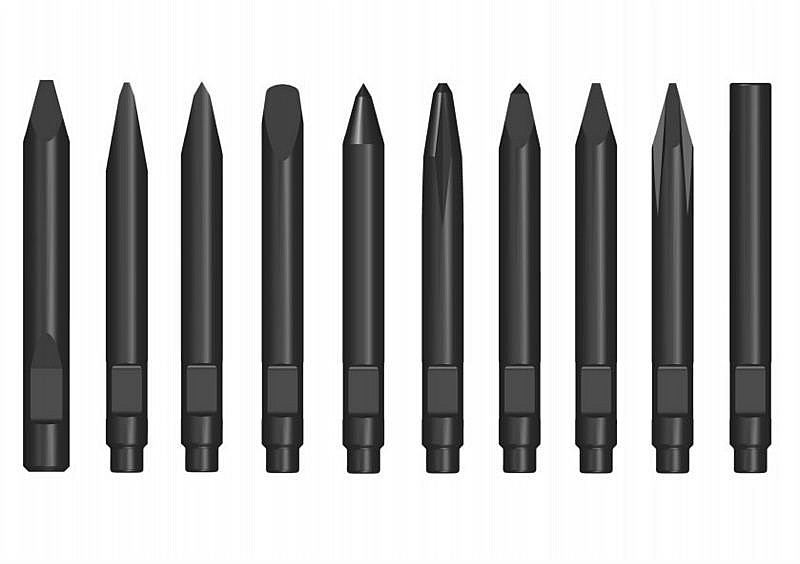
Choosing the correct chisel shape for the job is the first step in maximizing efficiency. SLYM Machinery manufactures different tool designs tailored for specific site conditions.
1. Cone Steel Chisel (Piercing & Splitting)
The Cone steel chisel, shaped like a pencil tip, is engineered for piercing and splitting action. It concentrates the hammer's energy onto a minimal contact point, generating powerful penetration.
Ideal Applications:
Unreinforced or lightly reinforced concrete.
Sedimentary rock and laminated stone.
High-hardness, seamy, or fractured rock (leveraging its splitting power).
Characteristics: Marvelous penetration through the point, powerful splitting energy transmitted outward, and minimal recoil/reverse impact on the hammer.
2. Flat Steel Chisel (Cutting & Structural Breaking)
The Flat steel chisel, resembling a stonemason's chisel, is one of the most widely used tools in hydraulic hammers.
Ideal Applications:
Heavy reinforced concrete (its shape is better suited for cutting and crushing structural materials).
Sedimentary rocks and breaking along high-hardness rock cracks.
Characteristics: Operates similarly to the cone chisel but features greater wear resistance due to its larger working surface. It is highly effective for structural demolition.
3. Blunt Steel Chisel / Moil Point (Crushing & Impact)
The Blunt (or Moil) chisel features a flat working head, primarily designed for compression and impact breaking, rather than penetration or splitting.
Ideal Applications:
Secondary breaking (reducing oversized rocks in quarries).
Compressive crushing operations on hard, non-seamy material.
Characteristics: Delivers maximum impact force over a wide area, relying on the hammer's high energy to crush the material efficiently.
IV. SLYM's Professional Advice: Maximizing Chisel Service Life
To ensure the lowest possible Total Cost of Ownership (TCO), our technical team recommends focusing on these maintenance points:
Timely Re-processing (Sharpening): When a chisel shows signs of wear, professional re-sharpening is crucial. Improper sharpening can alter the tool's heat treatment structure, leading to premature failure
Avoid Blank Firing and Ensure Lubrication: Blank firing (striking air) is the fastest way to destroy both the chisel and the hammer's internal components. Always ensure the contact area between the tool and the bushing is properly lubricated with high-temperature breaker grease to minimize internal friction wear.
Choose High-Quality Materials: SLYM utilizes premium alloy steel and precise, multi-stage heat treatment processes for all our tools. This ensures our chisels maintain optimal hardness for long service life while retaining the necessary toughness to resist fracture under continuous impact.
Conclusion and Call to Action (CTA)
Selecting the correct hydraulic rock breaker hammer and tool configuration is the critical factor in job site profitability. By choosing SLYM, you invest in superior performance, which significantly reduces both your initial purchase cost and your long-term operating and maintenance costs.
Welcome to consult our professional team or visit our factory at any time for guidance and assistance in selecting the perfect SLYM tool and hammer model for your specific carrier and application.
