You are here: Home » Products » Hydraulic breakers » Shop by Application/Capacity » Medium Range Hydraulic Breakers (12-28T) » SLYM SM140 Medium-Duty Hydraulic Breaker for 18-25 Ton Excavators
SLYM MACHINERY CO., LTD.
   katrina 
   0086-13912638104    Xushuguan Economic Development Zone, New District, Suzhou China 
If you have any questions please contact us !

loading

Share to:
sharethis sharing button

SLYM SM140 Medium-Duty Hydraulic Breaker for 18-25 Ton Excavators

In high-production quarrying, heavy demolition, and deep mining, equipment structural fatigue is an ongoing threat to operational profitability. Standard hydraulic hammers frequently suffer from sudden impact energy loss, severe piston scoring, and premature front head cracking when subjected to continuous operation in hard rock. The SLYM SM140 hydraulic breaker is engineered to neutralize these harsh job-site realities. Optimized for heavy demolition and high-density stone fragmentation, this attachment balances optimal fluid dynamics with maximum structural durability. By maintaining reliable nitrogen pressure stability and absorbing destructive recoil energy, the SM140 optimizes impact frequency while minimizing carrier boom wear. For fleet managers and project engineers, it represents a field-proven investment that ensures high hourly output, protects the excavator’s auxiliary infrastructure, and guarantees uncompromised uptime under high-load conditions.
Availability:
Quantity:
  • SM140

  • SLYM

  • China

  • 1pc

  • L/C, T/T

  • standard export packaging

  • 3-5days

  • 12 months

  • avalible

  • 18-26ton

Technical Features & International Standards


  • High-Quality Forged Steel Chisels: Precision-machined from heavy-forged tool alloy steel and subjected to advanced wear-resistant heat treatment to maximize structural durability and resist shattering in high-resistance strata.

  • Advanced Wear-Resistant Heat Treatment: Core dynamic components, including the internal cylinder housing and high-tolerance piston, undergo induction hardening and specialized stress-relief processing to prevent friction-induced mechanical scoring.

  • Reliable Nitrogen Pressure Stability: Features an engineered back-head gas chamber designed for superior nitrogen retention, ensuring steady impact energy delivery and stabilizing the optimal striking frequency across extended operational shifts.

  • High-End Durable Seal Kits: Outfitted with premium multi-stage international standard seal configurations capable of withstanding intense thermal cycling and protecting the circuit from microscopic oil contamination.

  • Carrier Weight Class Matching Logic: Precision-calibrated for heavy crawler excavators within the designated 18 to 25-ton class. This technical alignment matches the carrier's auxiliary hydraulic flow rates and operating pressure boundaries exactly, eliminating pump cavitation, reducing backpressure spikes, and preventing premature boom structural fatigue.


Job-Site Precautions & Troubleshooting


  • Strict Avoidance of Blank Firing: Operators must maintain solid downward pressure to ensure the chisel point is firmly pressed perpendicular against the rock face before executing the stroke. Blank firing sends high-amplitude shockwaves back into the piston face and tie rods, accelerating structural fracture.

  • Maintain Perpendicular Operational Positioning: Always position the breaker at a true 90-degree vertical angle to the material surface. Using the attachment to pry, lean, or drag rock introduces severe lateral stress, leading to inner front bushing binding, uneven striking paths, and catastrophic piston scoring.

  • Proactive Management of Oil Temperature and Contamination: Continuous hammering in hard rock generates rapid frictional heat within the host machine's hydraulic lines. Suspend operations if oil temperatures exceed safe limits. Inspect return filters frequently; managing hydraulic oil contamination is vital, as microscopic metal particles act as abrasives that destroy critical cylinder clearances.

  • Systematic Nitrogen Pre-Charge Verification: Routinely monitor the back-head gas thresholds using a dedicated testing kit. An incorrect low nitrogen pre-charge drastically cuts impact energy, resulting in soft hits, while over-charging creates excessive backpressure that can lock the piston completely and stall operations.
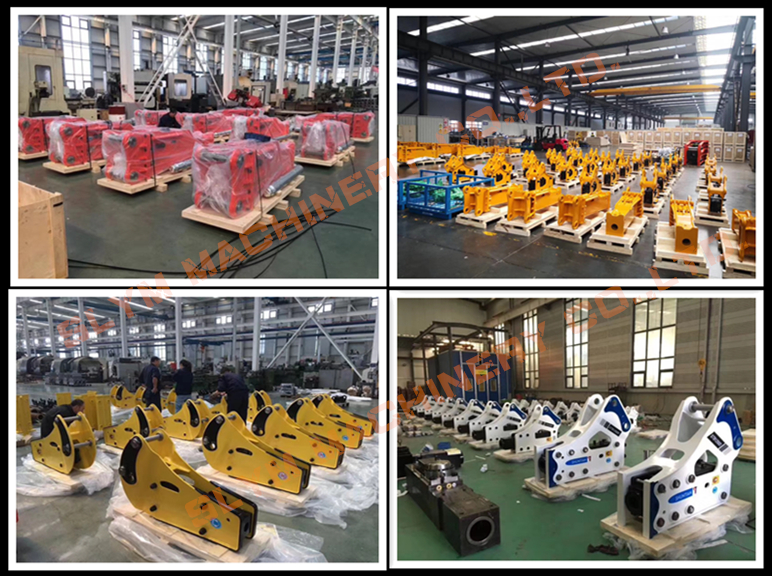

Our Service:

1)  Any your inquiry related our goods will be replied with 24 hours

2)  We can also provide OEM business

3) How to get the correct information of goods? Pls let us know the following news:

a. Your excavator model

b. The operation weigt of your excavator

c. The quantity of your order

d. Your destination port


         Items                                                      
          Units                                    
          SM140                                       
         Operating Weight

          kg

         ibs

          1,745

          3,867

         Working Pressure
          bar
          psi
          160~180
          2,320~2,610
         Maximum Pressure

          bar

          psi

          210

         3,045

         Operating Oil Flow
          l/min
          120~180
         Chisel Diameter
          mm
          140
        Impact Rate
          bpm
          300~500
         Impact Energy
          j
          kg.m
          4,961
          506
       
         Suitable Excavator
     
          ton
           ibs
          18~30
          39,680~66,135

SLYM Package_20200915105910

Q1: Why is my hydraulic oil turning black?

The Technician's Answer: "Black Oil" is a warning sign that contaminants are entering your system. This is usually caused by two things:

  • Aged Seals: If you haven't replaced your seal kits in over 6 months, the rubber begins to wear down into microscopic black particles.

  • Clogged Exhaust Screw: If the breather/exhaust screw is blocked by a mix of grease and dust, the waste cannot escape and gets forced back into the hydraulic circuit.

Solution: Replace the seal kit immediately and clean the exhaust screw with solvent.


Q2: My hydraulic hoses are jumping or vibrating violently. What's wrong?

The Technician's Answer: This is a classic symptom of a gas leak. When the nitrogen (N2) pressure in the back head or accumulator is too low or has leaked out entirely, the breaker loses its "cushion," causing the hydraulic oil to pulsate violently through the hoses.

Solution: Stop operation immediately. Check the nitrogen pressure and refill to the levels specified in your SLYM manual.


Q3: Why did my chisel (tool) or piston chip/break at the striking face?

The Technician's Answer: This is almost always caused by excessive clearance.

Check the gap between your chisel and the bushing. If it is greater than 5mm, the chisel will "tilt" or wobble inside the hammer.

When the piston hits a tilted chisel, the force is concentrated on one edge rather than the center. This causes "pitting" or metal chunks to fly off.

Solution: Replace bushings once they hit the 5mm wear limit


Q4: My hydraulic breaker has lost power and is hitting "weak." Why?

The Technician's Answer: Before blaming the cylinder, check these three things:

  • Nitrogen Pressure: Too much gas pressure can actually prevent the piston from traveling its full stroke; too little gas reduces the impact force.

  • Oil Temperature: If your oil is overheating (above 80°C), it loses viscosity, leading to internal pressure bypass.

  • Worn Seals: Internal leakage across the piston seals will reduce the striking power significantly.


Q5: What causes the tie-rods (through-bolts) to snap?

The Technician's Answer: The #1 killer of through-bolts is "Dry Firing" (firing the hammer without pressure on the chisel) or improper torque.

When you dry fire, the energy that should go into the rock goes into the hammer's own bolts and pins instead.

Solution: Ensure operators apply firm downward pressure before triggering. Check bolt torque every 50 operating hours.


Q6: How should I store my hydraulic breaker for the winter or off-season?

The Technician's Answer: Never leave it exposed to the elements.

  • Push the Piston Up: This is the most important step. By pushing the piston into the cylinder, you keep the polished metal surfaces coated in oil and safe from rust.

  • Bleed Nitrogen: This makes it easier to retract the piston and saves the seals from constant pressure.

  • Plug the Ports: Use steel plugs on all hose connections to keep moisture out.


Previous: 
Next: 

QUICK LINKS

Home
News

FOLLOW US

SUBSCRIBE TO NEWSLETTER

Copyright © 2019 SLYM MACHINERY CO.,LTD. All rights reserved.